


Alya at a glance
Alya
Early-harvest olive oil in a daily shot
- What it is
- One ingredient, extra virgin olive oil
- Polyphenols
- Alya reports 1,876 mg/kg
- Serving
- One 15 ml glass bottle
- Calories
- About 120 per tablespoon

Two morning shots, one clear pick
Vinegar has more pooled research on blood sugar after meals, and a lot of acid. A high-polyphenol olive oil shot is one measured, ready-to-drink tablespoon. Scored round by round.
Our verdict
For the first shot of the day, olive oil
A high-polyphenol olive oil shot is the better first-thing habit for most people. It gives you olive polyphenols in a measured tablespoon, it is a food with large diet trials behind it, and it is not an acidic drink.
Vinegar earns real credit on one point, more pooled research on blood sugar after meals, and it wins that round below. It ties on digestion, where neither shot has good trials, and trails on cravings, teeth and throat.
Alya verdict
Alya
Take one Alya shot, early-harvest Chetoui olive oil, 30 minutes before your first meal. Keep the vinegar for dressings, or dilute it and have it with food.
Shop & save 20%Wins 2 of 4 criteria
Pressed olives in one glass, fermented apples in the other
An olive oil shot is a tablespoon of extra virgin olive oil taken straight. An apple cider vinegar shot is a tablespoon or so of vinegar, usually stirred into water. People reach for both hoping for steadier blood sugar, calmer digestion and fewer cravings.
Alya at a glance
Alya
Early-harvest olive oil in a daily shot

ACV shot at a glance
ACV shot
Twice-fermented apple juice, diluted in water
The vinegar is apple juice fermented twice, first into alcohol and then into acetic acid. That sour acid makes up about 5% to 6% of the bottle, according to Cleveland Clinic.
The usual apple cider vinegar shot recipe is short: 1 tablespoon of vinegar in a mug of warm water. That dilution comes from Cleveland Clinic dietitian Beth Czerwony, who also suggests starting with a few drops and staying under 2 tablespoons a day. An ACV shot taken neat skips the water, and that is the version Cleveland Clinic warns about.
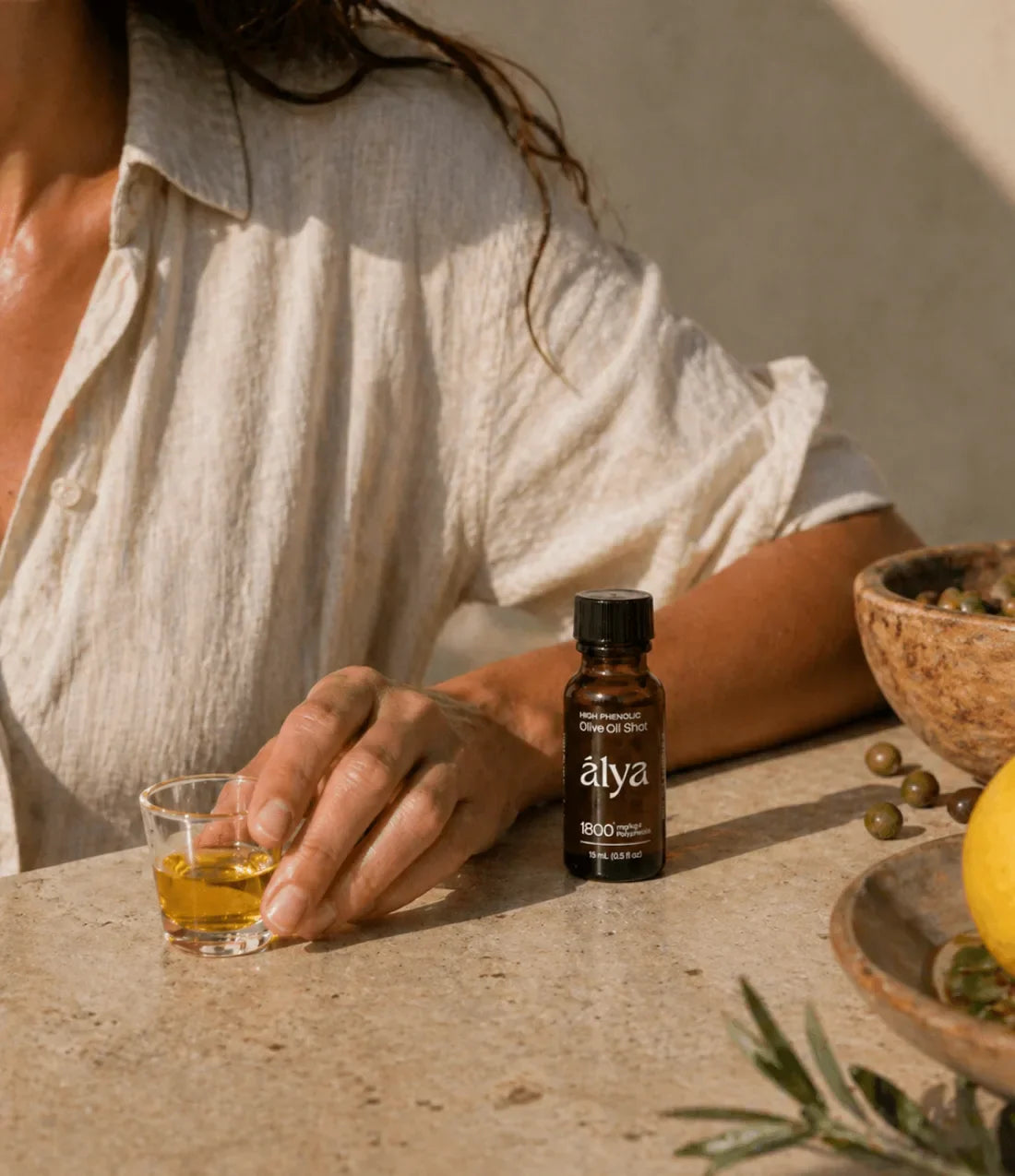
Our shot is the other kind. Alya is one ingredient, early-harvest Chetoui extra virgin olive oil from Maya's family farm in Testour, Tunisia, in a 15 ml glass bottle. Nothing is mixed in. Alya reports 1,876 mg/kg total polyphenols, tested by the World Olive Center for Health in Athens. Polyphenols are the plant compounds behind a fresh oil's peppery bite, and they are the reason we bottle it as a shot.
Real, modest & mostly about blood sugar
The honest list of apple cider vinegar shot benefits is short. The best-studied one is a smaller rise in blood sugar after a starchy meal. The limits are the acid itself and how small most of the studies are.
Much of the interest traces back to the vinegar & insulin study, a small 2004 paper in Diabetes Care on people with insulin resistance or type 2 diabetes. As UChicago Medicine gastroenterologist Edwin McDonald describes it, participants ate a bagel with butter and orange juice, with 20 grams of apple cider vinegar or a placebo, and blood sugar after the meal was lower with the vinegar.
Later reviews lean the same way. A 2017 meta-analysis in Diabetes Research and Clinical Practice pooled trials of vinegar taken with a meal and found lower glucose and insulin responses afterward. A 2021 meta-analysis of nine apple cider vinegar trials, each at least 2 weeks long, some in people with type 2 diabetes, found fasting glucose about 8 mg/dL lower overall. In the apparently healthy participants, fasting glucose appeared to rise instead.
Cleveland Clinic's summary is plain. The vinegar might lower glucose a little, most studies are small, and no real science backs the heartburn claims. Harvard Health adds that nobody has shown the best time of day to drink it or the ideal amount.
Side effects come with apple cider vinegar shots too. Cleveland Clinic lists enamel erosion, a burned esophagus from undiluted vinegar, nausea, lower potassium, and interactions with insulin, water pills, laxatives and some blood pressure medicines.
Polyphenols first, with bigger trials behind them
Two things carry olive oil shot benefits: the oleic acid every olive oil has, and the polyphenols only some oils have in quantity. The research is larger than vinegar's, and most of it studied olive oil as part of a diet.
The biggest trial is PREDIMED, published in the New England Journal of Medicine. It assigned 7,447 adults in Spain at high cardiovascular risk to a Mediterranean diet with extra virgin olive oil, the same diet with nuts, or advice to cut fat. After a median of 4.8 years, the olive oil group had fewer major cardiovascular events than the reduced-fat group. That was a whole diet in older, high-risk adults. It was never a shot.
Polyphenols were tested more directly in the EUROLIVE trial in Annals of Internal Medicine. Two hundred healthy men took 25 ml a day of olive oils with low, medium or high polyphenol content, 3 weeks each. HDL cholesterol rose and markers of oxidative stress fell in step with the polyphenol content. The oils were otherwise similar, which is why we say not all olive oils are equal. For the compounds themselves, read the science of polyphenols.
The FDA allows a qualified claim that about 1.5 tablespoons (20 grams) a day of oils high in oleic acid, a group its 2018 review names olive oil in, may reduce the risk of coronary heart disease when they replace fats higher in saturated fat and do not add to the calories you eat in a day. It calls that evidence supportive but not conclusive. One 15 ml shot is a little under 14 grams.
None of these studies tested Alya, and none tested a single morning shot. A tablespoon of any olive oil is about 120 calories, per USDA data, so count it as food. The National Institute of Diabetes and Digestive and Kidney Diseases lists high-fat foods among those commonly linked to reflux symptoms. If you have reflux or gallbladder problems, are pregnant or take medication, check with your doctor first.

Four rounds, scored on the evidence we opened
Each round is scored out of 10 for the strength of the evidence and for how the shot treats your body. Vinegar wins one round, and we say so.
| Criteria | Alya | ACV shot |
|---|---|---|
| Main compounds | Olive polyphenols & oleic acid | Acetic acid |
| Blood sugar research | Two small single-meal studies | Meal studies & two meta-analyses |
| Large diet trials | Yes, on olive oil diets | Small, short studies |
| Tooth enamel | Not an acidic drink | Acid can erode enamel |
| Needs diluting | No, ready to drink | Yes, in water |
| Calories per tablespoon | About 120 | About 3 |
| Taste | Peppery & buttery | Sour |
One note before the scores. Maya wore a glucose monitor for 30 days and logged her meals with and without her shot. You can read Maya's GLP-1 glucose log. She says herself that it is not a perfectly controlled experiment, so it counts toward no score below.
Vinegar takes this round. It has the 2004 meal study and the 2017 meta-analysis of vinegar taken with meals.
Olive oil has smaller evidence of the same kind. In a 2015 crossover study in Nutrition & Diabetes, 25 healthy adults had lower blood glucose 2 hours after a Mediterranean-style lunch with 10 grams of extra virgin olive oil than after the same lunch without it. In a 2018 study, 20 healthy adults who took 20 mg of oleuropein, an olive polyphenol, right before lunch also had lower glucose 2 hours later.
Both were single meals in small groups, and neither tested Alya.
A tie, because neither shot has earned the win. We searched PubMed and found no trial in healthy adults that measured bloating after olive oil or after vinegar.
Vinegar slows how fast the stomach empties. In a 2007 pilot study of 10 people with type 1 diabetes whose stomachs already emptied slowly, it slowed things further.
For olive oil, what we have is Alya's own customer survey: 79% reported less bloating and 74% reported more regular digestion, based on a survey of 200 participants over a 90-day period using the daily protocol. A customer survey has no control group, so it adds no points here.
Olive oil edges it, on comfort more than proof. Vinegar can blunt appetite, but in a 2014 study in the International Journal of Obesity the effect came with higher nausea ratings, and the authors concluded that promoting vinegar as a natural appetite suppressant does not seem appropriate.
Olive oil has no trial showing a morning shot curbs cravings, and a 2009 trial in 29 healthy men found meals rich in olive oil, walnuts or dairy fat about equally satisfying. Alya's own customer survey, where 68% reported fewer cravings, has no control group, so like the bloating figures it adds no points.
A clear win for the oil. Vinegar is highly acidic. Cleveland Clinic warns that it can erode tooth enamel and that undiluted vinegar can burn the esophagus. The American Dental Association describes dental erosion as acid dissolving the hard tissue of the tooth, and it names acidic drinks and snacks as the dietary risks. It also notes some evidence that excessive use of vinegar-based dressings may add to erosion. Olive oil is a fat and is not on that list.
What you will feel with a fresh, high-polyphenol oil is a peppery catch at the back of the throat. It comes from oleocanthal, one of the polyphenols. Not every olive oil has it. Alya does because it is high in polyphenols. You may make a face the first time, and it is honestly not that bad.
They already meet in every vinaigrette
Long before anyone stacked them as shots, olive oil and apple cider vinegar were a salad dressing. We searched PubMed for a trial of the two taken as one shot and found none, so there is no evidence the pair does more together.
On food is the easy way to have both. Cleveland Clinic suggests working vinegar into a dressing, sauce or marinade, and moderation is the sensible rule there too. Whisk it with any good olive oil and lunch is dressed.
As drinks, keep them apart. Take your Alya shot the way we recommend it, on an empty stomach, 30 minutes before your first meal. Have the vinegar later, diluted, with food.
One ingredient, one tablespoon, before breakfast
Our pick for a daily habit is an olive oil shot in the morning. It delivers polyphenols in a measured dose, and nothing about it needs diluting.
The habit is older than the brand. "I'd watch my grandfather drink a tablespoon of our olive oil each morning," Maya told Appetito magazine in 2026. Our protocol is the same idea with a clock on it: one shot on an empty stomach, 30 minutes before your first meal, every morning.
What goes in the bottle matters more than the ritual. Alya's olive oil shot is cold pressed, unfiltered and sealed in amber glass, 15 ml at a time. Store it somewhere cool and dark. There is no need to refrigerate it and nothing to measure.
On November 16, 2026, the 30 Days supply was $77.59 on subscription, about $2.59 a shot, or $96.99 as a one-time order. Subscriptions ship free and can be paused or canceled anytime.
Vinegar still has a place. Keep it in your dressings in moderation, or well diluted with a meal if your doctor has no objection. For the first thing you swallow each morning, we would hand you the olive oil.

Who Alya is best for
A measured daily dose of olive polyphenols
Who ACV shot is best for
A sour add to meals, well diluted
Alya pros & cons
Pros
Cons
ACV shot pros & cons
Pros
Cons
Short answers on the two shots
For most people, yes, in small amounts and diluted. Cleveland Clinic's dietitian says the evidence so far shows apple cider vinegar is safe for most people in small amounts, and suggests no more than 2 tablespoons a day, watered down. Check with your doctor first if you take insulin, water pills or blood pressure medicine, or have low potassium, kidney disease or gastroparesis.
You can. Olive oil and vinegar in one glass make an unwhisked vinaigrette. We found no study that tested the combined shot, so expect nothing extra from mixing. The vinegar is still acidic, so dilute it and look after your teeth. We suggest taking Alya on its own and saving the vinegar for a meal.
The olive oil is gentler. Vinegar is highly acidic, and Cleveland Clinic warns that its acid can erode tooth enamel, which does not come back once it wears away. The American Dental Association names acidic drinks and snacks as dietary causes of erosion. Olive oil is a fat and is not among them. If you drink vinegar, dilute it first.
Keep reading

What polyphenols do in the body, and the five compounds a lab in Athens measured in Alya's oil.
AlyaOn alyahealth.com
How Maya went from a SIBO diagnosis back to her family's Chetoui grove in Tunisia, and why the oil became a daily shot.
Maya AyedOn alyahealth.com
Why an early-harvest, single-origin oil from northern Tunisia keeps its polyphenols, and what a morning shot does for gut and skin.
AlyaOn alyahealth.comTap a supply to add
90 days work out to $1.70 a shot on subscription
Tap a delivery to subscribe
Pause, skip or cancel anytime


