


Olive oil before bed
A night shot can work, but morning still wins
How to take olive oil in the evening without inviting reflux, what the research says about sleep, and why we still take ours in the morning.
- Save 20% to 30%on every subscription
- $1.70 a shot90 days on subscription
- 1,876 mg/kgpolyphenols, as Alya reports
- Free shippingon subscriptions
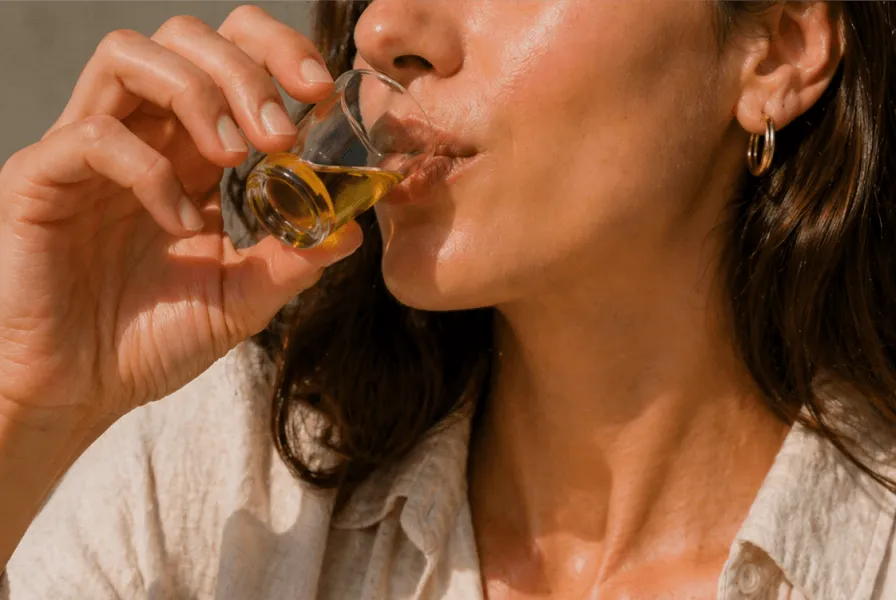
Why people take olive oil at night
Convenience, curiosity & a few big promises
Olive oil before bed is often pitched online as a route to deeper sleep or a calmer gut by morning. We found no study that gave people olive oil at bedtime and measured their sleep. Digestion has a little more behind it: in one small 2015 trial of 50 people on dialysis, a few milliliters of olive oil a day improved constipation scores, but no study has tested it at bedtime. The everyday reasons people move their shot to the evening are simpler, and some of them are good ones.
For most people, taking olive oil at night is about the clock. Mornings are a blur of alarms, coffee and getting out the door, and the evening is the one quiet window left. Some people skip breakfast and would rather have nothing until lunch, so the shot drifts to the end of the day. Others simply like closing the day with a small ritual.
Those are honest reasons to try olive oil at night. A habit you keep is worth more than a perfect protocol you skip. The catch is that a tablespoon of oil is food, and food close to bedtime comes with a few rules worth knowing.
Our own protocol is one shot on an empty stomach, 30 minutes before your first meal, every morning. We have never published guidance on night shots, so this is our first honest look at the question: how to do it well if evenings suit you, what the research can and cannot say, and why we still take ours in the morning.
How to take an olive oil shot before bed
Four steps for a gentler evening shot
A night shot works best when it rides along with dinner, not with your pillow. These four steps keep the habit easy on your stomach and your sleep. They lean on reflux and sleep guidance, because no study has tested olive oil shots at bedtime.
- Time
- 1 minute
- Difficulty
- Easy
- Steps
- 4
If you're new to Alya's olive oil shots, each one is a single 15 ml dark glass bottle of high-polyphenol extra virgin olive oil from early-harvest Chetoui olives on our family farm in northern Tunisia. One bottle is one serving, so there is nothing to measure. The steps below apply to any olive oil shot before bed, ours or a spoonful from the bottle in your kitchen.
-
Leave two hours after dinner
Finish dinner & your shot two to three hours before bed
Gastroenterologists already have a rule for evening food. The American College of Gastroenterology's 2022 reflux guideline suggests avoiding meals within 2 to 3 hours of bedtime, and notes that a gap of under 3 hours between eating and lying down is linked with more reflux symptoms. For people who get reflux at night, the NIDDK suggests eating at least 3 hours before lying down.
A shot is small, but it is pure fat. So treat it as part of dinner: take it with your meal or soon after, then leave 2 to 3 hours before you lie down, and at least 3 if heartburn ever bothers you at night. That window also lines up with the Sleep Foundation's hygiene guide, which advises against dining late and says any food before bed should be on the lighter side.
-
Keep it to one shot
One tablespoon, about 120 calories, once a day
One shot is one tablespoon, 15 ml. Like any olive oil, that is about 120 calories, according to USDA FoodData Central. It is a modest amount, and it still counts toward your day.
Studies that name a bigger amount are counting a whole day of olive oil, not one shot. The diet questionnaire used in the PREDIMED trial gave a point for 4 or more tablespoons of olive oil a day, counting oil for cooking, salads and meals out (Schröder and colleagues, Journal of Nutrition, 2011). The EU's olive oil polyphenol claim is set at 20 g a day, about 1.5 tablespoons. Your shot is the measured part of that daily total, and the rest can come from the oil on your plate.
If you already take a morning shot, a second one at night doubles that to about 240 calories. Pick one time of day for the shot. If evening is your time, let the night shot replace the morning one rather than join it.
-
Sip it straight or with lemon
Take the peppery bite neat, or soften it
Good early-harvest, high-polyphenol extra virgin olive oil is intensely green and peppery, with a slow burn at the back of your throat. That catch comes from oleocanthal, one of the olive's natural polyphenols. Sip it straight from the bottle in one go or two small swallows, then follow with a glass of water.
That burn is not for everyone. One customer left this tip in a review on our product page: "Def would recommend mixing this shot with fresh squeezed lemon juice or something citrus though." That is one customer's tip, not our direction. At night, go easy on it. Citrus is one of the foods the NIDDK lists as a common reflux trigger, so if your stomach is sensitive, drink the shot straight and chase it with water instead.

Straight or with a little lemon. At night, keep the citrus light. -
Skip it on nights reflux flares
On heartburn nights, save it for the morning
High-fat foods sit on the NIDDK's list of common reflux triggers, alongside chocolate, coffee, mint, spicy foods and alcohol. Lying down makes things worse, because gravity is no longer helping keep stomach acid down, as the Sleep Foundation explains in its guide to reflux and sleep.
So on nights when heartburn is already brewing, skip the shot and take it the next morning instead. You keep the daily habit and leave the evening risk behind.
Benefits of drinking olive oil before bed
Same oil, same polyphenols, any hour
We found no research showing olive oil does anything special at night. The fat and polyphenols in the bottle are the same at 7 a.m. and 10 p.m., and the studies behind olive oil's reputation never timed it to bedtime.
Olive oil is mostly monounsaturated fat, about 73% by weight in USDA's figures. Harvard's Nutrition Source describes olive oil as the primary added fat in a Mediterranean diet, replacing other oils and fats like butter and margarine. The swap is the point, not the extra spoonful.
The big trials tested olive oil as part of a whole way of eating. In PREDIMED, 7,447 people at high cardiovascular risk were assigned to a Mediterranean diet with supplied extra virgin olive oil, a version with nuts, or a reduced-fat control diet. Over a median of 4.8 years, the olive oil group had about a 30% lower risk of major cardiovascular events than the control group. That was a diet followed for years, not a shot at a particular hour.
Then there are polyphenols, the compounds behind good oil's bitterness and bite. The EU allows olive oil with enough of them to say its polyphenols contribute to the protection of blood lipids from oxidative stress, with the effect tied to a daily intake of 20 g. The rule names an amount per day, not a time, and one 15 ml shot is about 14 g, a little under that amount. Alya reports 1,876 mg/kg total polyphenols, tested by the World Olive Center for Health in Athens, and you can read more about the science of polyphenols on our site.
Sleep is where the night claims live, and it is where the evidence is thinnest. We found no trial that gave people olive oil at bedtime and measured their sleep. A 2022 review of observational studies linked closer adherence to the Mediterranean diet with adequate sleep duration and better sleep quality. In a 2026 cross-sectional study of 500 Spanish adults, closer adherence was tied to better self-reported sleep, but not to sleep measured with wrist sensors. Both looked at the whole diet, not olive oil on its own, and neither can show cause and effect.
So the honest list of benefits of olive oil before bed is short. You get the same oil you would get in the morning, on a schedule that suits you, and that is a fine reason on its own.
| What you'll hear | What the research shows |
|---|---|
| It helps you sleep | No bedtime trial; diet links are observational |
| It works better overnight | We found no study comparing timing |
| It digests while you rest | Eating close to lying down is linked with reflux |
How much olive oil before bed
One shot is plenty, at any hour
One shot, one tablespoon, is enough for an evening. That is how much olive oil before bed we would suggest, and only when it replaces your morning shot rather than adding to it.
A tablespoon of olive oil weighs about 13.5 g and carries about 120 calories, by USDA FoodData Central's numbers. Our bottles hold one 15 ml serving, and our direction is one a day. We found no research suggesting a bigger dose works better at night, and more fat late in the evening is more for your stomach to handle before sleep.
Harvard's Nutrition Source makes a point worth carrying here. It says not to simply add olive oil to your current diet, but to adopt the Mediterranean pattern as a whole. Let the shot stand in for other fats, like the butter on your toast or a heavier dressing at dinner.
If you're pouring from a regular bottle at home, measure a level tablespoon rather than pouring by eye. Keep night shots small and steady.
Olive oil shot morning or night: which wins
Morning wins for us, night can still work
Morning wins for us, mostly for practical reasons, and night is a fair second choice. No trial has settled the best time to drink olive oil morning or night, so what follows is our judgment, laid out so you can make your own.
A morning shot goes down on an empty stomach, and you stay upright for hours afterward, so reflux is less of a worry. It sits 30 minutes before your first meal, which is how we built our protocol. It also pairs easily with a routine you already have.
Meal pairing has a little research behind it, and the research is small. In one crossover study of 25 healthy adults, a Mediterranean-style lunch with 10 g of extra virgin olive oil was followed by lower blood glucose two hours later than the same lunch without it. That was oil eaten as part of a meal, not a shot taken before one, and it did not test Alya. A shot taken alone at bedtime sits next to no meal at all.
Maya tracked her own version of this. Maya's GLP-1 glucose log covers a month on a glucose monitor, with some days taking a shot 30 minutes before carb-heavy meals and some days skipping it. It is one person's readings, and as she writes herself, it isn't a perfectly controlled experiment. Read it as her experience, not as proof.
Maya's tip for night shots: if you tend to snack in the evening or get cravings at night, take your shot a little before the time they usually show up. As our product page puts it, a shot of good fat is satisfying enough to take the edge off until your next meal. Keep the same 2 to 3 hour gap before you lie down.
Night earns its place when it is the only time you will remember. Steady daily intake matters more to us than the hour, and the EU's polyphenol claim is framed around a daily amount, not a time. If evenings are when the habit sticks, take your shot with dinner and keep a 2 to 3 hour gap before bed.
Back at the grove, Maya's grandfather still takes his olive oil with breakfast. We are with him on this one.
| Factor | Morning shot | Night shot |
|---|---|---|
| Stomach | Empty, 30 minutes before food | Best taken with or after dinner |
| Next to a meal | Yes, your first meal | Only if taken with dinner |
| Reflux risk | Upright for hours afterward | Higher if you lie down soon |
| Effect on sleep | None claimed | None shown in research |
| Habit fit | Pairs with a morning routine | Pairs with a wind-down routine |
| Evening cravings | Taken hours before they start | Take it before your usual craving time |

Before bed FAQs
Quick answers before you pour
Short answers to the questions we hear most about night shots.
Why drink olive oil at night instead of the morning?
Most people who drink olive oil at night do it for convenience: mornings are rushed, or they eat nothing until lunch. That is a fair reason. We found no research showing night beats morning for olive oil's benefits, and no trial has tested olive oil at bedtime for sleep. If evening is the only time you will keep the habit, take it with dinner and leave 2 to 3 hours before bed.
Can drinking olive oil before bed upset your stomach?
It can for some people. High-fat foods are a common reflux trigger, and a short gap between eating and lying down is linked with more reflux symptoms. If you get heartburn, take your shot in the morning, or with dinner at least 3 hours before lying down, as the NIDDK suggests for nighttime reflux. Talk to your doctor if reflux keeps waking you.
Does a night shot help you sleep?
We can't say it does. We found no trial that tested olive oil at bedtime for sleep. Observational studies link the whole Mediterranean diet with better self-reported sleep, but a 2026 study of 500 Spanish adults found no link when sleep was measured with wrist sensors. A light evening and a steady bedtime routine are the better-supported bets.
Olive oil shot reading
Keep reading

The science of polyphenols in olive oil
What polyphenols do in the body, and the five compounds a lab in Athens measured in Alya's oil.
AlyaOn alyahealth.com
It begins in Carthage: the Alya family grove
How Maya went from a SIBO diagnosis back to her family's Chetoui grove in Tunisia, and why the oil became a daily shot.
Maya AyedOn alyahealth.com
5 reasons to start mornings with high-polyphenol olive oil & why origin matters
Why an early-harvest, single-origin oil from northern Tunisia keeps its polyphenols, and what a morning shot does for gut and skin.
AlyaOn alyahealth.comTap a supply to add
90 days work out to $1.70 a shot on subscription
Tap a delivery to subscribe
Pause, skip or cancel anytime


