


Does olive oil break a fast
A shot breaks a fast. Your goal decides the rest
One shot is about 120 calories of fat. How to fit it around time-restricted eating, keto and modified fasting days, and when to keep it out.
- Save 20% to 30%on every subscription
- $1.70 a shot90 days on subscription
- 1,876 mg/kgpolyphenols, as Alya reports
- Free shippingon subscriptions
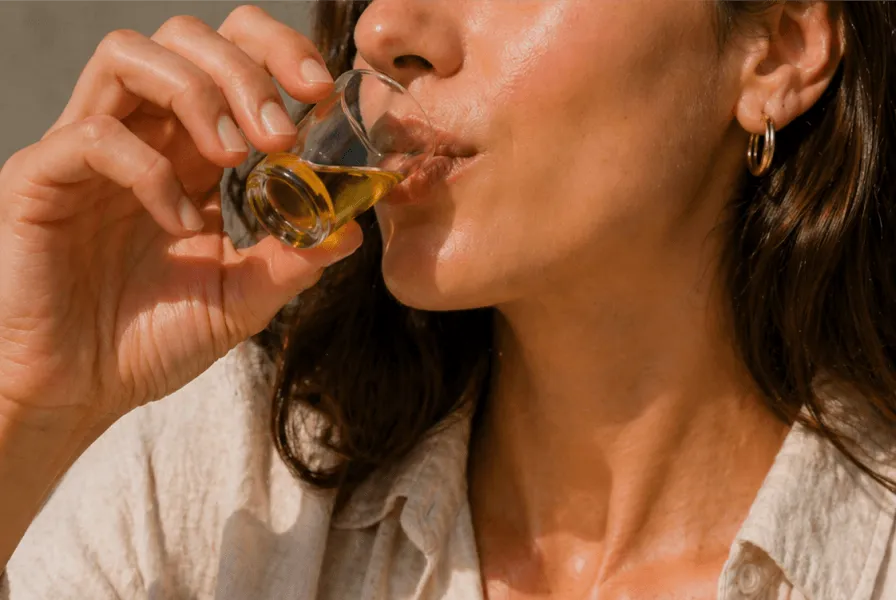
Does olive oil break a fast, by fasting goal
Why you fast decides what a shot costs
If you came here asking does olive oil break a fast, the short answer is yes. One tablespoon carries about 120 calories, and a strict fast allows none. What that costs you depends on why you fast, so we have split the answer by goal.
Start with the olive oil calories. USDA FoodData Central puts olive oil at 884 calories per 100 g, and a tablespoon weighs 13.5 g, which works out to about 120 calories. All of it comes from fat. The same entry lists 0 g of carbohydrate and 0 g of protein. One Alya shot is 15 ml, one tablespoon, so the math is the same for ours as for any olive oil.
Fasting itself comes in several shapes. Harvard's fasting diet review describes intermittent fasting as cycling between brief periods of fasting, with either no food or significant calorie reduction, and periods of unrestricted eating. It groups the common methods into alternate-day fasting, whole-day fasting such as the 5:2 approach, and time-restricted feeding, where you eat inside a set window each day. Some of those plans allow food on fasting days. Some allow nothing.
The same review is measured about results. A systematic review it summarizes found weight loss with intermittent fasting, but in the 12 clinical trials that compared it with ordinary daily calorie restriction, there was no significant difference in weight loss or body composition. Harvard's bottom line is that benefits seen with calorie restriction in animal studies have not been observed with intermittent fasting in humans, and that strong recommendations on intermittent fasting for weight loss cannot be made at this time. The National Institute on Aging goes further: it says there is insufficient evidence to recommend any type of calorie restriction or fasting diet, and that you should talk with your healthcare provider before making a significant change to how you eat.
Two rows in the table below deserve a closer look. Autophagy, the cell's recycling system, is a popular reason to fast. A 2026 review in Biochemical Society Transactions found that human data are much more limited than the animal work, and that the few studies measuring the more rigorous readout, called autophagic flux, often come back negative or inconclusive. We found no human study of what a tablespoon of oil does to it, so we won't claim a shot keeps you in it or knocks you out of it. If autophagy is your reason, keep the fast clean.
Lab work is the simplest case. MedlinePlus says fasting for a blood test means nothing to eat or drink except plain water, usually for 8 to 12 hours. A shot of high-polyphenol extra virgin olive oil is food, so it waits until after the draw.
| Why you fast | Does a shot break it? | A practical fit |
|---|---|---|
| Time-restricted eating | Yes, it is food | Make it the first thing in your window |
| 5:2 or alternate days | It counts, about 120 calories | Fit it into that day's budget |
| Ketosis | Ends a zero-calorie fast, adds no carbs | Fits keto macros, count the calories |
| Gut rest | Yes, it is food | Wait for your eating window |
| Autophagy | Unknown in humans | Keep the fast clean |
| Blood test or medical fast | Yes, plain water only | Take it afterward |
How to fit an olive oil shot into intermittent fasting
Four ways to time a shot around a fast
Our own protocol is one shot on an empty stomach, 30 minutes before your first meal, every morning. We have never published guidance for fasting schedules, so the four options below are practical choices, not Alya rules. Pick the one that matches your goal.
- Time
- 1 minute
- Difficulty
- Easy
- Steps
- 4
If you're new to Alya's olive oil shots, each one is a single 15 ml dark glass bottle of high-polyphenol extra virgin olive oil from early-harvest Chetoui olives on our family farm in northern Tunisia. One bottle is one tablespoon, so there is nothing to measure, which helps when you are counting. The steps work the same with a level tablespoon from any bottle in your kitchen.
We found no study that tested olive oil shots at a particular point in a fasting schedule. So treat any olive oil intermittent fasting routine, these four included, as a question of fit. Choose the one you will keep.
-
Take it as the first bite of your eating window
Open your eating window with the shot
This option sits closest to our own protocol. If your window opens at noon, take your shot at 11:30 and eat at noon. Count the window from the shot, since that is when your fast ended.
Maya tracked her own version of a shot before food. Maya's GLP-1 glucose log covers a month on a glucose monitor, with some days taking a shot 30 minutes before carb-heavy meals and some days skipping it. It is one person's readings, and as she writes herself, it isn't a perfectly controlled experiment. The same page explains GLP-1, a hormone your own gut releases when you eat, and sums up a few small studies of olive oil or its compounds. None of them tested Alya. Read the log as her experience, not as proof.
Thirty minutes. One shot. Then whatever meal breaks your fast.

One bottle is one tablespoon, which makes it easy to count. -
Or take it to close the window
Close your window with the shot after your last meal
If your fasting hours fall in the morning, the shot can move to the other end of the day. Take it with your last meal or right after it, then start your fast. Your fasting hours stay clean, and the shot rides along with food you were eating anyway.
We take ours in the morning, and an evening shot has one catch. High-fat foods are on the NIDDK's list of foods commonly linked to reflux symptoms. If heartburn bothers you at night, take the shot with an earlier meal or use the first option instead.
-
Keep strict fasts strict
Keep water-only & medical fasts free of oil
Some fasts have no room for a tablespoon of anything. Fasting before a blood test is one. MedlinePlus says plain water only, and to tell your provider if you ate or drank anything else, since you may need to reschedule. A fast your doctor has set before a procedure is another.
The same goes for any fast that depends on zero calories to do its job, like the autophagy question above. Take your shot when the fast ends. You keep the daily habit, and the fast stays a fast.
-
Count it on modified fasting days
Count the shot on 5:2 & alternate days
Modified fasting days allow some food, so a shot can fit. Harvard describes the 5:2 approach as a 400 to 500 calorie diet on two days of the week, and alternate-day fasting as one meal with about 25% of your daily calorie needs on fasting days. One shot is about 120 calories, roughly a quarter of a 500-calorie day.
Take it with that day's meal and let it stand in for another fat, like butter or a heavy dressing, rather than adding to one. Harvard's Mediterranean diet review makes a related point: it says not to simply add olive oil or nuts to your current diet, but to adopt the whole Mediterranean plan. On a fasting day, every calorie has a job.
Olive oil fasting & the dirty fasting debate
A popular idea with almost no research
Olive oil fasting, a spoonful of oil during hours when you otherwise eat nothing, sits in a gray zone that has picked up a name: dirty fasting. It is an informal term, and we found no study that has tested it.
Dirty fasting describes taking in some calories during a fasting window, often milk and sweetener in coffee or a cup of bone broth. Healthline's overview notes that the term isn't used in the medical community and has no set definition, and that people who practice it typically take in up to 100 calories. Clean fasting means no calories at all during the fasting hours.
The case for it is about staying power. Advocates say a few calories don't technically break a fast and make a schedule easier to keep. The case against is about definitions and evidence. Any calories mean you are technically not fasting, and Healthline notes there is no evidence that dirty fasting works as well as clean fasting for the benefits people fast for, such as autophagy or blood sugar.
A shot fits the dirty fasting label poorly anyway. At about 120 calories, it already runs past the 100 calories dirty fasters typically stop at, and it is pure fat rather than a splash in a coffee cup.
So we leave the label alone. We have no fasting rule of our own, but if a shot helps you stick to a schedule, the simplest fit is the edge of your eating window, where it counts as food and nobody has to argue about it. Clean fasting hours. A clear first bite. No gray zone.
Olive oil on an empty stomach
Why we take ours before food & who should wait
We take olive oil on an empty stomach because that is the protocol we built Alya around. The reasoning is ours and the research on timing is thin, so here is what we say, what we can't prove, and who should check with a doctor first.
Our science page puts the case this way: "This is the window your body is most ready to absorb fat-soluble compounds. Your stomach is empty. There is nothing competing for absorption." That is our reasoning for a morning shot, not a result from a study of our shots. You can read more about the science of polyphenols on our site. Alya reports 1,876 mg/kg total polyphenols, tested by the World Olive Center for Health in Athens.
Expect a bite. High-polyphenol extra virgin olive oil from early-harvest Chetoui olives is intensely green and peppery, with a slow burn at the back of your throat. That catch comes from oleocanthal, one of the olive's natural polyphenols.
A tablespoon of fat on its own doesn't suit every stomach. High-fat foods are on the NIDDK's list of foods commonly linked to reflux symptoms, and the NIDDK also notes that gallbladder attacks often follow heavy meals. A single shot is a small amount of food, but if you live with reflux or gallbladder trouble, ask your doctor before adding a daily tablespoon of fat.

Is olive oil keto
Zero carbs & all fat, an easy keto fit
Yes. Olive oil has no carbohydrate at all, which makes it one of the simplest fats to fit into keto. What a shot does to ketosis itself is a separate question, and we don't have evidence to answer it.
Keto plans are built around carbohydrate. Harvard's Nutrition Source says a ketogenic diet typically keeps total carbohydrate under 50 grams a day, sometimes as low as 20, and that popular keto resources suggest about 70% to 80% of calories from fat. It lists olive oil among the plant fats keto plans allow.
That makes the olive oil keto math simple. A tablespoon carries about 120 calories, 13.5 g of fat and 0 g of carbohydrate, by USDA's numbers. Our product page lists Daily Olive Oil Shots as keto compliant, which speaks to those macros. It says nothing about your ketone levels, and neither do we.
Harvard also points out that most keto plans allow foods high in saturated fat, and that the diet can be adjusted to emphasize foods low in saturated fat, such as olive oil. If you choose to start a ketogenic diet, it recommends working with your doctor and a dietitian.
| Per tablespoon (13.5 g) | Olive oil |
|---|---|
| Calories | About 120 |
| Total fat | 13.5 g |
| Saturated fat | About 1.9 g |
| Monounsaturated fat | About 9.8 g |
| Polyunsaturated fat | About 1.4 g |
| Carbohydrate | 0 g |
| Protein | 0 g |
Fasting FAQs
Quick answers before your next fast
Short answers to the fasting questions we hear most.
Will olive oil calories kick you out of ketosis?
Not through carbohydrate, because olive oil has none. A tablespoon is about 120 calories of pure fat, and keto plans get most of their calories from fat. We found no study that measured ketone levels after a single tablespoon during a fast, so we can't say exactly what a shot does to your readings. If you test your ketones, check your own numbers.
Can you take an olive oil shot during a fast for gut comfort?
You can, but it ends the fast, because a shot is about 120 calories of food. We found no study that tested olive oil during a fast for gut comfort, and Maya writes on her GLP-1 page that "we found no study in healthy adults that measured bloating after olive oil." If you fast to rest your gut, take the shot when your window opens.
Is olive oil keto friendly every day?
Yes, as far as carbohydrate goes: one tablespoon has 0 g. Harvard's Nutrition Source lists olive oil among the fats keto plans allow and names it among the foods low in saturated fat a keto plan can lean on. Count its roughly 120 calories in your day, and if you start keto, Harvard recommends doing it with your doctor and a dietitian.
Olive oil shot reading
Keep reading

The science of polyphenols in olive oil
What polyphenols do in the body, and the five compounds a lab in Athens measured in Alya's oil.
AlyaOn alyahealth.com
It begins in Carthage: the Alya family grove
How Maya went from a SIBO diagnosis back to her family's Chetoui grove in Tunisia, and why the oil became a daily shot.
Maya AyedOn alyahealth.com
5 reasons to start mornings with high-polyphenol olive oil & why origin matters
Why an early-harvest, single-origin oil from northern Tunisia keeps its polyphenols, and what a morning shot does for gut and skin.
AlyaOn alyahealth.comTap a supply to add
90 days work out to $1.70 a shot on subscription
Tap a delivery to subscribe
Pause, skip or cancel anytime


