


Alya at a glance
Alya
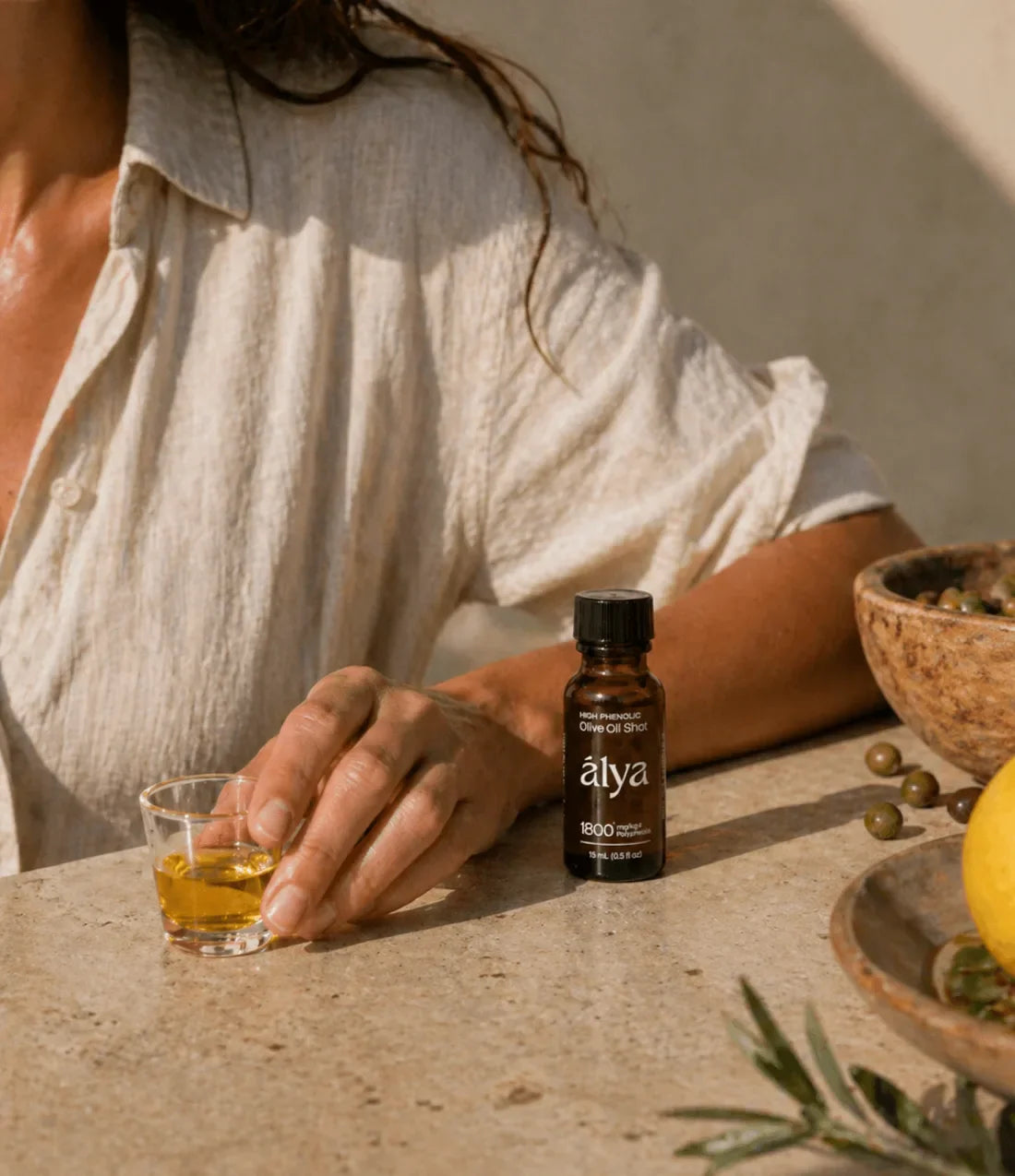
Early-harvest olive oil in a daily shot
- Oil
- Single-origin, high-polyphenol Chetoui extra virgin olive oil
- Polyphenols
- Alya reports 1,876 mg/kg
- Serving
- One 15 ml glass bottle
- Best use
- Raw, every morning

Two good fats. One belongs in your morning shot.
Avocado oil takes the smoke point. Extra virgin olive oil takes polyphenols and the research. Here is how we scored each, with sources.
Our verdict
Cook with avocado oil, drink olive oil
On the terms that matter for a daily habit, olive oil wins this comparison, thanks to polyphenols and the depth of research behind them. Avocado oil earns real points too. It has a higher smoke point and nearly the same fat profile, which makes it a strong cooking oil.
Our four health scores reflect that: avocado oil ties on fat but trails on polyphenols, vitamin E and human research. Smoke point sits outside those scores, and avocado oil wins it outright. For a raw daily dose, an extra virgin olive oil with a high polyphenol count is the stronger choice, and that is what goes into every Alya shot.
Alya verdict
Alya
Keep avocado oil by the stove for high heat. For your morning ritual, take one shot of high-polyphenol extra virgin olive oil from early-harvest Chetoui olives.
Shop & save 20%Wins 3 of 4 criteria
Same main fat, very different extras
Olive oil vs avocado oil looks like a close race on the nutrition label. Both oils are mostly oleic acid and both land near 120 calories a tablespoon. Both cook well at home.
Alya at a glance
Alya
Early-harvest olive oil in a daily shot

Avocado oil at a glance
Avocado oil
A green oil pressed from avocado flesh
The gap opens in the smaller compounds. Extra virgin olive oil carries olive polyphenols such as hydroxytyrosol, the family the EU health claim for olive oil is measured on. Avocado oil answers with a higher smoke point.
So the avocado oil vs olive oil question really depends on the job. One suits the hot pan. The other suits a raw daily habit, which is the one we care about most.
Four criteria, scored on the evidence
Here is avocado oil vs olive oil health compared on four criteria, each scored out of 10. Alya stands in for the olive oil side and generic avocado oil for the other, since no single avocado oil brand speaks for the category.
| Criteria | Alya | Avocado oil |
|---|---|---|
| Main fat | Oleic acid, about 71% | Oleic acid, about 68% |
| Polyphenols | Alya reports 1,876 mg/kg | Lower total phenolics in studies |
| EU polyphenol claim | Written for olive oil | Not covered |
| Vitamin E | Higher in a 2012 heating study | Lower in that study |
| Smoke point | EVOO 350 to 410°F, per NAOOA | 482°F or higher, per AOCS Inform |
| Flavor | Peppery, green, pleasantly bitter | Grassy, buttery, avocado-like |
| Human research | Large trials on olive oil diets | A few short studies |
| Shelf quality | Third-party lab results published | Most stale or mixed in a 2020 test |
Most avocado vs olive oil debates start with fat and stop there. On fat alone, the two oils look like siblings. Most olive oil vs avocado oil health questions get settled further down, in the polyphenols and in how much human research sits behind each oil.

Call this one a tie. Per USDA FoodData Central, a tablespoon of olive oil (13.5 g) has about 119 calories, 9.8 g of monounsaturated fat, 1.9 g saturated and 1.4 g polyunsaturated. A tablespoon of avocado oil, which USDA weighs at 14 g, has about 124 calories, 9.9 g monounsaturated, 1.6 g saturated and 1.9 g polyunsaturated.
The main fat in both is oleic acid, about 71 g per 100 g in olive oil and about 68 g in avocado oil. Harvard on types of fat lists olive oil and avocados among foods high in monounsaturated fat, and notes that eating good fats in place of saturated fat lowers LDL cholesterol. Either oil does that job well.
This is where the oils split. Olive oil is known for hydroxytyrosol, tyrosol and their relatives, including oleocanthal and oleacein. EU law allows one specific claim for olive oil with at least 5 mg of hydroxytyrosol and its derivatives per 20 g, which works out to 250 mg/kg. The claim reads that olive oil polyphenols contribute to the protection of blood lipids from oxidative stress, and it is written for olive oil only.
Alya reports 1,876 mg/kg total polyphenols, tested by the World Olive Center for Health in Athens. Per kilogram of oil, that is about 7.5 times the 250 mg/kg level. The claim itself is tied to 20 g of olive oil a day, a point we come back to below.
If you want the compound by compound version, read the science of polyphenols on our site.
Phenolic compounds show up in avocado oil too, just fewer of them. A 2019 review of avocado oil research in the journal Molecules reports studies showing avocado oil has a lower concentration of total phenolic compounds than olive oil, though its measured antioxidant activity was similar. That similar activity is why avocado oil scores 4.5 here and not lower. Its main antioxidant is vitamin E, which comes next.
Close, with a small edge to olive oil. In a 2012 University of Navarra study that heated both oils at 180°C (356°F), olive oil started with more vitamin E than avocado oil, 35.5 mg vs 24.5 mg per 100 g. Avocado oil's vitamin E also ran out sooner, at 4 hours of heating vs 5.
Treat that as one lab comparison, not a rule. Researchers writing for the American Oil Chemists' Society put avocado oil's alpha tocopherol, its main form of vitamin E, at 70 to 190 mg/kg. USDA lists olive oil at about 144 mg/kg. The ranges overlap, so the gap here stays small.
Olive oil has large human trials behind it. In PREDIMED, 7,447 Spanish adults at high cardiovascular risk followed a Mediterranean diet with extra virgin olive oil, a Mediterranean diet with nuts, or a reduced-fat control diet. Over a median of 4.8 years, the olive oil group had about a 30% lower risk of major cardiovascular events than the control group. That trial tested a whole diet with supplied oil, not a shot, and it did not test Alya.
The human record for avocado oil is much thinner. The 2019 Molecules review describes a study in 13 healthy adults who swapped butter for avocado oil for six days and showed better after-meal readings for insulin, glucose and blood fats. A 2021 review, written with the industry-funded Avocado Nutrition Center, counted 19 clinical trials on fresh Hass avocados, but those study the whole fruit with its fiber, which the oil leaves behind. A six-day study is a start, and the score reflects it.
Avocado oil takes this round
On the avocado oil smoke point vs olive oil question, avocado oil wins, and we will say so plainly. Researchers writing in Inform, the American Oil Chemists' Society magazine, list cold-pressed Hass avocado oil at 250°C (482°F) or higher.
Extra virgin olive oil smokes lower. The North American Olive Oil Association, an olive oil trade group, gives a typical range of 350 to 410°F for extra virgin olive oil and 390 to 470°F for refined olive oil. The spread comes from free fatty acids. A 2025 University of Barcelona study of 48 virgin olive oils found free fatty acid content was the main driver of smoke point, so oils with fewer free fatty acids smoke later.
Smoke point is a rough guide. The Barcelona team notes the test still relies on a visual reading, and the NAOOA argues that an oil's stability matters more, pointing to olive oil's oleic acid and minor compounds. The 2012 Navarra study tested that directly at 180°C. Olive oil showed more of one oxidation marker after 3 hours, avocado oil lost its vitamin E sooner, and the authors judged the two oils similar overall.
Numbers also vary by bottle. Studies of South American avocado oils summarized in the 2019 Molecules review put its thermal stability near 176°C (349°F), well under the Inform figure.
Sear with one, finish with the other
For avocado oil vs olive oil for cooking, match the oil to the heat. Avocado oil suits a very hot pan, and everyday olive oil handles most home cooking. A high-polyphenol extra virgin olive oil like Alya belongs off the heat.
The NAOOA puts average stovetop cooking at about 350°F, inside the typical range for extra virgin olive oil. Sautéing vegetables or simmering a sauce works fine with it. For a hard sear or a stir-fry at full blast, avocado oil gives you more room before it smokes, and its grassy, buttery flavor suits most savory dishes.
Our own advice for Alya is simple. Heat can degrade some of the polyphenols you are paying for, so we recommend Alya raw, as a morning shot or a finishing drizzle, with a more heat-stable oil for the pan. Avocado oil is a fine pick for that pan. Save your high-polyphenol extra virgin olive oil for food that never sees heat.
| Kitchen job | Better pick | Why |
|---|---|---|
| Hard sear or stir-fry | Avocado oil | Higher smoke point |
| Everyday sauté | Either oil | Both handle about 350°F |
| Salad, dip or drizzle | High-polyphenol extra virgin olive oil | No heat on the polyphenols |
| Morning shot | Alya | A measured 15 ml, taken raw |
Polyphenols decide it. They start in the grove.
On avocado oil vs extra virgin olive oil, the fat is a draw and the smoke point goes to avocado. What tips it is polyphenol content, and that is where a daily olive oil shot earns its place.
Polyphenol levels in olive oil are set by everything that happens before bottling. Our Chetoui trees grow in Testour, in Tunisia's Medjerda River Valley, rainfed and unirrigated. We harvest early, when polyphenols in the fruit peak, and press within hours. The oil stays unfiltered, because filtering strips phenolic compounds along with sediment, and it goes into dark glass sealed at the source.
Alya's daily olive oil shot is that oil in a 15 ml bottle, one tablespoon. One shot on an empty stomach, 30 minutes before your first meal, every morning. Alya reports 1,876 mg/kg total polyphenols, tested by the World Olive Center for Health in Athens. One honest note: the EU olive oil polyphenol claim is written for 20 g of oil a day, and one shot weighs a little under 14 g.
The habit is older than the brand. Maya grew up in Tunisia, where her grandfather still drinks olive oil with breakfast. When she sent the family oil to a lab, in her words, "the results came back high. Really high." You can read Maya's story from Carthage on our site.
As a cooking fat, avocado oil does its job well. For a raw daily dose of olive polyphenols, it cannot stand in for extra virgin olive oil, and an early-harvest, high-polyphenol extra virgin olive oil packs more of them into each spoonful.

Who Alya is best for
Your raw daily polyphenol ritual
Who Avocado oil is best for
High-heat cooking with a buttery flavor
Alya pros & cons
Pros
Cons
Avocado oil pros & cons
Pros
Cons
Quick answers on the two oils
If you want the short version of avocado oil vs olive oil which is healthier for a daily habit, it is high-polyphenol extra virgin olive oil. The details and the honest caveats are below.
Extra virgin olive oil is the healthier everyday pick for most people, mainly because of its polyphenols and its research record. Both oils are rich in oleic acid and fit a balanced diet. Avocado oil makes sense for high-heat cooking, while a high-polyphenol extra virgin olive oil earns its place raw, as a drizzle or a morning shot.
Neither oil has been shown to cause weight loss, so avocado oil vs olive oil for weight loss is a tie. Each tablespoon carries about 120 calories. In PREDIMED, people on a Mediterranean diet with extra virgin olive oil and no calorie limit showed no significant difference in body weight versus a reduced-fat control diet. Count your shot as part of your day's calories.
You can, since avocado oil is a food oil, but you would be taking a fat with fewer phenolic compounds than a high-polyphenol extra virgin olive oil. Human research on the oil itself is thin, such as one six-day study in 13 adults. Quality is a gamble too. A 2020 UC Davis test found at least 82% of samples stale or mixed with other oils.
Keep reading

What polyphenols do in the body, and the five compounds a lab in Athens measured in Alya's oil.
AlyaOn alyahealth.com
How Maya went from a SIBO diagnosis back to her family's Chetoui grove in Tunisia, and why the oil became a daily shot.
Maya AyedOn alyahealth.com
Why an early-harvest, single-origin oil from northern Tunisia keeps its polyphenols, and what a morning shot does for gut and skin.
AlyaOn alyahealth.comTap a supply to add
90 days work out to $1.70 a shot on subscription
Tap a delivery to subscribe
Pause, skip or cancel anytime


