


Olive oil for gut health
What olive oil can & can't do for your gut
Polyphenols first. What studies of olive oil and gut bacteria show, where they stop, and how one daily shot fits a gut-friendly morning.
- Save 20% to 30%on every subscription
- $1.70 a shot90 days on subscription
- 1,876 mg/kgpolyphenols, as Alya reports
- Free shippingon subscriptions
Key takeaways
The short version
- Gut bacteria break down some olive oil polyphenols, and in one small trial a polyphenol-rich oil raised those compounds in stool after 3 weeks.
- Extra virgin olive oil is linked with a healthier mix of gut bacteria mostly as part of a whole Mediterranean diet, and we found no study of a morning shot on its own.
- We found no trial in healthy adults that measured bloating after olive oil, so our bloating figures come from Alya's own customer survey.
- A gut health shot is one tablespoon (15 ml) of high-polyphenol extra virgin olive oil, about 120 calories, taken raw.
- Olive oil has no fiber and no live bacteria, so it belongs next to fiber, water and fermented drinks.
Chapter 01
Is olive oil good for gut health
A good fat with a promising, unfinished story
Yes, as far as the research goes, and it helps to know how far that is. Extra virgin olive oil is the main fat in the Mediterranean diet, an eating pattern that research ties to a more varied set of gut bacteria.
Those bacteria have a name. The National Institute of Diabetes and Digestive and Kidney Diseases (NIDDK) calls the bacteria in your digestive tract your gut flora or microbiome, and says they help with digestion.
Most of the olive oil research asks what a whole diet does to them. A few small human trials look at the oil itself. The ones in this guide did not test Alya, and none tested a single morning shot. Simon Poole, a physician who teaches nutrition for the Olive Oil Times sommelier program, drew the same line when he told Olive Oil Times in 2023: "Olive oil is at the heart of the Mediterranean diet in combination with other foods, which will certainly improve the diversity and health of the gut microbiome, though rather less research on drinking olive oil on its own."
Alya began with a gut problem, so we care about getting this right. Maya's story from Carthage includes a line many readers will recognize: "It began with relentless bloating, the kind that hurt." She was later diagnosed with SIBO, small intestinal bacterial overgrowth, and tried, in her words, "every supplement I could find." That is what sent her back to the oil her family grows and into the research on it. Her page never says olive oil cured anything, and neither do we. It is one person's experience, and we keep it apart from the evidence.
Not all olive oils are equal. The part of the oil researchers connect to gut bacteria is its polyphenols, and the amount varies a lot from one bottle to the next.
Chapter 02
How olive oil polyphenols feed gut bacteria
What reaches your colon & what happens there
Polyphenols are compounds a plant makes to protect itself, and an olive makes its own set. Some of them reach your colon, the last stretch of the gut, where bacteria break them down. We keep the compound-by-compound detail on the science of polyphenols page. Here is the gut part.
In the lab, then in people. Researchers in Spain mixed four olive oil phenols with human gut bacteria in a lab model. The bacteria turned some of them into smaller compounds called phenolic acids. The team then gave volunteers 25 ml a day of a phenol-enriched olive oil for 3 weeks and found more free hydroxytyrosol, one of olive oil's main polyphenols, in their stool, along with two of those acids.
One small trial. In a randomized crossover trial, 12 adults with high cholesterol took 25 ml a day of raw virgin olive oil for 3 weeks at a time. One oil had 80 mg/kg of phenols, meaning 80 milligrams in each kilogram of oil. One was enriched to 500 mg/kg with olive phenols. A third was enriched with olive and thyme phenols together. The olive-enriched oil raised hydroxytyrosol in stool but did not change the bacteria the researchers counted. The olive and thyme oil increased bifidobacteria, a group usually counted among the helpful ones.
The whole diet. A 2025 paper in the journal Nutrients, the Mediterranean gut microbiota review, pulls the wider research together. It describes a diet high in plants, monounsaturated fat and polyphenols, "primarily from extra virgin olive oil," as favoring bacteria such as Bifidobacterium and Roseburia. Those bacteria make short-chain fatty acids, which the authors tie to a stronger gut barrier. It is a narrative review of the whole diet, animal studies included. It calls the results often heterogeneous, and its authors ask for longer clinical trials.
So the case for olive oil for gut health is real and modest. Bacteria do use these compounds. Whether a daily dose grows more of the helpful bacteria in people is not settled, and the trials used 25 ml a day, more than one 15 ml shot.
Chapter 03
Olive oil for digestion & bloating
What happens after the shot goes down
This chapter separates how your body handles the oil from what anyone has measured.
How the oil is digested. Olive oil is fat, and your body has a set routine for fat. Per NIDDK, your liver makes bile, a digestive juice that helps digest fats. Your gallbladder stores it between meals and squeezes it into the small intestine when you eat, and juice from your pancreas carries the enzymes that break the fat down.
Bloating. NIDDK says gas enters the digestive tract in two ways: you swallow air, and bacteria in your large intestine break down undigested carbohydrates. Olive oil has no carbohydrate at all (USDA FoodData Central, FDC ID 171413). That tells you what the oil is made of. It does not show that a shot eases bloating, and in the write-up of her own 30-day glucose log on our site, Maya says so plainly: "we found no study in healthy adults that measured bloating after olive oil, so I won't tell you the science proves it."
What our customers report. In Alya's own customer survey, 79% reported less bloating and 74% reported more regular digestion. The fine print reads, "Based on a survey of 200 participants over a 90-day period using the daily protocol." These are customers' own answers and the method is not published, so read them as experience, not as a trial.
Staying regular. NIDDK's advice for regularity is fiber with plenty of liquids, which help the fiber work better. We could not find a trial of an olive oil shot and regularity in healthy adults.
Fat on an empty stomach does not suit everyone. If you have gallbladder problems, reflux or another medical condition, are pregnant, or take medication, check with your doctor before starting a daily shot. NIDDK also says to talk with your doctor if gas symptoms bother you, change suddenly, or come with other symptoms such as abdominal pain, constipation or diarrhea.
| The question | What we can say today |
|---|---|
| Is olive oil good for digestion | Your body digests it like any fat. Few studies measure digestion itself |
| Does it ease bloating | No trial in healthy adults has measured it that we could find |
| Does it keep you regular | No trial of a shot in healthy adults that we could find |
| What do Alya customers say | 79% reported less bloating in Alya's own survey of 200 |
Chapter 04
What a daily gut health shot looks like
One tablespoon, raw, before breakfast
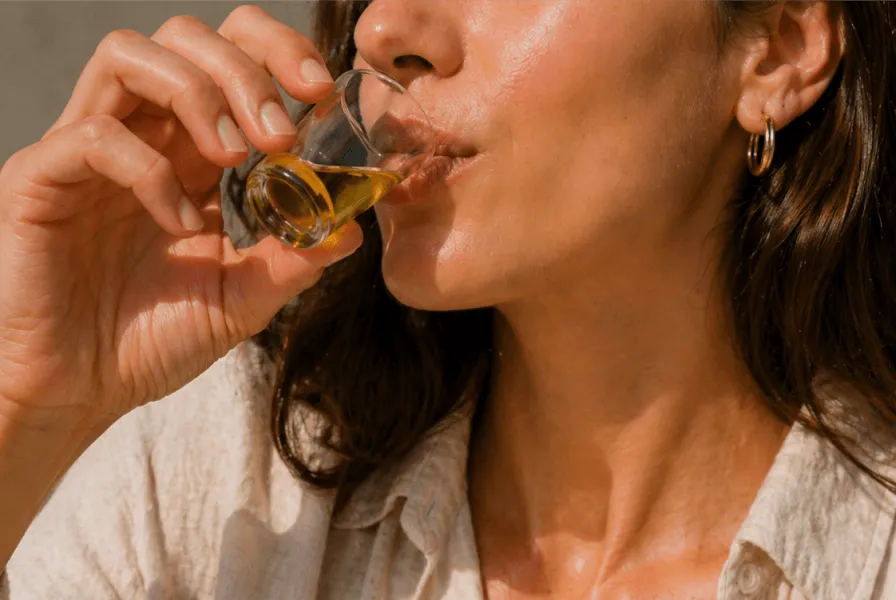
A gut health shot is simple on purpose. It is one tablespoon of high-polyphenol extra virgin olive oil, taken raw, at the same time every day.
Our protocol fits in two sentences: "One shot on an empty stomach, 30 minutes before your first meal, every morning. That's the entire protocol." Maya described her own mornings to Appetito magazine in March 2026: meditation, the gym, then "a shot of the olive oil about 30 minutes before my first meal."
Alya's daily olive oil shot comes in single-serve amber glass bottles of 15 ml, which is one tablespoon. There is one ingredient: early-harvest Chetoui extra virgin olive oil from our family farm in Testour, Tunisia. A daily olive oil shot is easier to keep up when there is nothing to pour or measure. Each one is about 120 calories, like any tablespoon of olive oil.
Expect a peppery catch at the back of your throat. Not every olive oil has it. Alya does because it is high in polyphenols, and one of them, oleocanthal, sets off a receptor that, inside the mouth, sits mostly in the throat. You may make a face the first morning. It is not that bad, and a squeeze of lemon is fine if you like it. The lemon is only for taste.
If straight oil before breakfast does not sit well with you, our own FAQ gives a second way to take it: "either on its own as a shot or drizzled over your favorite foods." Keep the oil raw either way. The same FAQ notes that heat can degrade some of the polyphenols.
The 30 Days supply is $96.99 one time or $77.59 on subscription. We read those prices on November 16, 2026.

Chapter 05
Gut health drinks compared
Where an olive oil shot sits among gut drinks
Gut health drinks do different jobs. Some hydrate, some carry live bacteria, and an olive oil shot carries polyphenols. The table sets them side by side.
The best drinks for gut health are the ones that fill a gap in what you already eat and drink. Fermented foods have a well-known trial behind them. In a 17-week randomized study at Stanford, healthy adults were assigned to a high-fiber diet or a diet high in fermented foods, 18 people in each group. In the fermented-food group, the variety of gut bacteria went up steadily and markers of inflammation went down. That was a full diet of fermented foods, not one bottle a day.
Among drinks for gut health, an olive oil shot is the polyphenol option: one ingredient, one measured tablespoon. It brings no live cultures, so it sits beside the others. Nothing in this table replaces anything else in it.
That goes for our bottle too. Alya has no added probiotics, no prebiotic fiber and no adaptogens. The ingredient list is extra virgin olive oil and stops there.
Fiber still does the heavy lifting. Harvard's Nutrition Source says dietary fiber is broken down and fermented by the bacteria living in your colon, which releases short-chain fatty acids. Olive oil has 0 grams of fiber, so take your shot and then eat the oats, the beans or the fruit.
| Drink | What it brings | What the evidence says |
|---|---|---|
| Water | Fluid | NIDDK: liquids help fiber work better and make stools softer and easier to pass |
| Kefir | Live bacteria | Harvard lists it among probiotic foods that may contain beneficial live microbes |
| Kombucha | Fermented tea with live bacteria | On the same Harvard list. Heating or pasteurizing after fermentation destroys the bacteria |
| A probiotic shot | Selected live strains | NCCIH: different types of probiotics may have different effects |
| An olive oil shot | Polyphenols and monounsaturated fat | Gut bacteria break down its polyphenols. Small trials, none on shots |
Chapter 06
Best olive oil for gut health
Pick for polyphenols, freshness & proof
The best olive oil for gut health is one that still carries its polyphenols when it reaches you. Four checks cover most of it.
Extra virgin. The authors of a large European olive oil trial open with the reason: virgin olive oils are richer in phenolic content than refined olive oil.
A polyphenol number with a lab's name on it. In the small trial above, the oils ran from 80 to 500 mg/kg, and it was the olive-enriched 500 mg/kg oil that raised hydroxytyrosol in stool. That trial did not test Alya or any oil above 500 mg/kg. Ask who tested an oil and when. Alya reports 1,876 mg/kg total polyphenols, tested by the World Olive Center for Health in Athens.
A recent harvest. Polyphenols fade in the bottle. When Spanish researchers stored 160 extra virgin olive oils in the dark at 20°C, phenolic content fell by 42% on average after 12 months.
Dark glass, kept cool. Store your oil somewhere cool and dark, away from direct light and heat. There is no need to refrigerate it.
Alya was built around that list. It is a single variety, Chetoui, picked early, cold pressed within hours and left unfiltered. One ingredient, in a dose you do not have to measure.

Gut health FAQs
Three questions before your first shot
Short answers on timing, on pairing, and on the one side effect to know about.
Does olive oil help with digestion right away?
Probably not in a way you would notice on the first morning. Your body digests olive oil like any fat, using bile and enzymes from the pancreas, and we found no study that timed an effect from a single shot. Alya says most people notice changes in energy and digestion within 2 to 4 weeks of daily use. We don't promise timelines. Bodies are not on a schedule.
Which drinks for gut health pair well with an olive oil shot?
Water is the easy one, and a fermented drink such as kefir or kombucha adds live bacteria that olive oil does not have. Our protocol puts the shot 30 minutes before your first meal, so take it first and have the other drink with breakfast. Lemon in the shot is fine for taste. Then eat something with fiber.
Can a daily olive oil shot cause loose stools?
Possibly, though we found no study that measured it for a shot. Olive oil is pure fat, and NIDDK tells people who have diarrhea to avoid foods that are high in fat because they could make it worse. If straight oil first thing does not agree with you, take the same tablespoon with food. If it continues, stop and check with your doctor.
Olive oil shot reading
Keep reading

The science of polyphenols in olive oil
What polyphenols do in the body, and the five compounds a lab in Athens measured in Alya's oil.
AlyaOn alyahealth.com
It begins in Carthage: the Alya family grove
How Maya went from a SIBO diagnosis back to her family's Chetoui grove in Tunisia, and why the oil became a daily shot.
Maya AyedOn alyahealth.com
5 reasons to start mornings with high-polyphenol olive oil & why origin matters
Why an early-harvest, single-origin oil from northern Tunisia keeps its polyphenols, and what a morning shot does for gut and skin.
AlyaOn alyahealth.comTap a supply to add
90 days work out to $1.70 a shot on subscription
Tap a delivery to subscribe
Pause, skip or cancel anytime


