


Alya at a glance
Alya
Early-harvest Chetoui oil in a daily shot
- Grade
- Extra virgin
- Processing
- Cold pressed, unfiltered, unrefined
- Polyphenols
- Alya reports 1,876 mg/kg
- Best use
- Raw, every morning

Same olives, very different polyphenols
One oil is pressed and left alone. The other is refined, then blended. That single step decides which bottle belongs in your morning shot.
Our verdict
Cook with either. Drink the extra virgin.
For an olive oil shot, extra virgin is the grade to use, and a high-polyphenol one is the whole point. It is pressed and left alone, so it keeps the polyphenols that refining removes.
A bottle sold as plain olive oil is a blend of refined and virgin oils. It has the same monounsaturated fat, a neutral flavor and a lower price, which makes it a good cooking oil. It was never the one to drink for polyphenols.
Alya verdict
Alya
For your morning shot, Alya: early-harvest Chetoui extra virgin olive oil, never refined, with a reported polyphenol number. Keep a regular olive oil by the stove for cooking.
Shop & save 20%Three grades, sorted by how the oil is handled
Extra virgin olive oil vs olive oil is really a question of grade. Extra virgin and virgin oils are pressed and left alone. Refined oil is processed further, and the bottle sold as plain olive oil is a blend of the two kinds.
Alya at a glance
Alya
Early-harvest Chetoui oil in a daily shot

Regular oil at a glance
Regular oil
Refined olive oil with some virgin added
These definitions come from the International Olive Council's oil grades. USDA's voluntary US grade standards, in effect since October 25, 2010, follow the same lines. Virgin oils are obtained from the olive solely by mechanical or other physical means, with no treatment beyond washing, decantation, centrifugation and filtration.
One more virgin grade never reaches a shelf. Lampante oil has too much free acidity or too many flavor faults to be eaten as it is, so the Council says it is intended for refining or technical use.
| Grade | How it is made | Free acidity limit | Flavor rule (USDA) |
|---|---|---|---|
| Extra virgin | Mechanical means only | 0.8 g per 100 g | No defects, some fruitiness |
| Virgin | Mechanical means only | 2 g per 100 g | Reasonably good flavor & odor |
| Refined | Virgin oil, then refining | 0.3 g per 100 g | Flavorless & odorless |
| Olive oil | Refined & virgin oils blended | 1 g per 100 g | Acceptable, like virgin oil |
One is pressed. The other is pressed, refined & blended.
The difference between olive oil and extra virgin olive oil is what happens after the press. Extra virgin stops there. Regular olive oil goes on to a refinery, then gets some virgin oil stirred back in.
All olive oil starts the same way. The North American Olive Oil Association, the industry's US trade group, says every grade is extracted mechanically, without chemical solvents. Then the oil is graded, and the best-tasting oil that meets the purity limits can be sold as extra virgin, with only minimal processing such as filtration.
Oil that misses the mark can be refined, which the trade group describes as a purification process that removes flavor and color. USDA's standard describes refined olive oil the same way, as flavorless and odorless, and it lets producers add back alpha-tocopherol, a form of vitamin E, lost in refining. Before bottling, refined oil is typically blended with about 15% to 20% virgin or extra virgin oil for some taste and color.
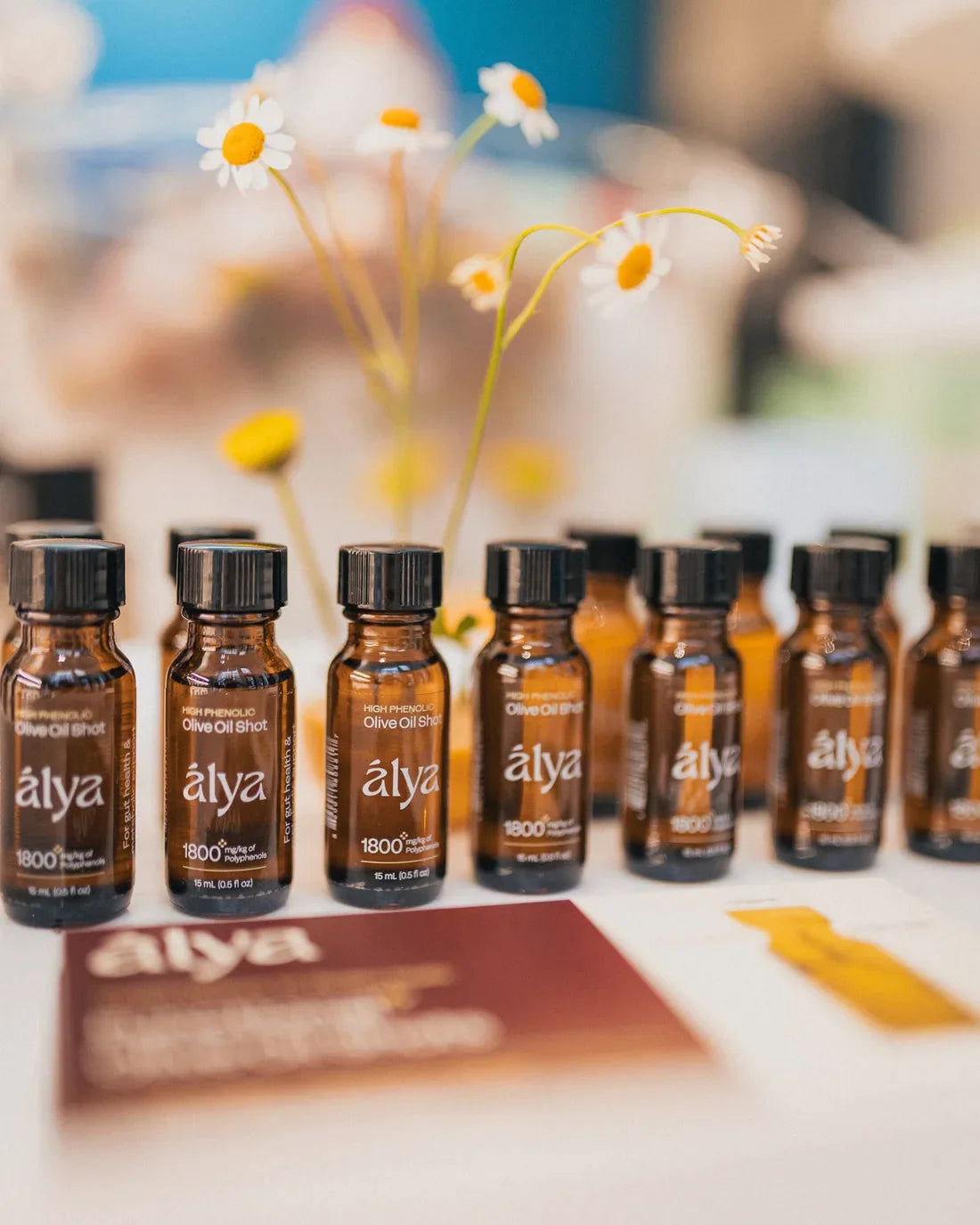
So the olive oil vs extra virgin olive oil choice is between an oil that was pressed and bottled and one that was pressed, refined and blended. Alya sits at the unprocessed end. Our oil is cold pressed within hours of harvest and left unfiltered, with no heat and no refining.

Refining keeps the fat & loses most of the rest
Both oils give you the same oleic acid. Polyphenols are another story. They are the plant compounds behind an oil's bitterness and pepper, and by the trade group's own estimate regular olive oil carries around 15% to 20% of what extra virgin does.
Why that matters shows up in the EUROLIVE trial, published in Annals of Internal Medicine. Researchers gave 200 healthy men 25 ml a day of three olive oils that were otherwise similar, with 2.7, 164 or 366 mg/kg of polyphenols, for 3 weeks each. HDL cholesterol rose and markers of oxidative stress fell in step with the polyphenol content. Its authors concluded that olive oil is more than a monounsaturated fat.
Even the words extra virgin do not settle it. A University of Córdoba study measured 1,239 Spanish extra virgin olive oils over two seasons and found phenol levels anywhere from 1 to 2,850 mg/kg. Not all of them reached 250 mg/kg, the level behind the EU's olive oil polyphenol claim.
That spread is why we lead with a number. Alya reports 1,876 mg/kg total polyphenols, tested by the World Olive Center for Health in Athens. Our Chetoui olives are harvested early, while the polyphenols are at their peak. For the compounds themselves, read the science of polyphenols.
None of these studies tested Alya. And the EU claim is written for 20 grams of olive oil a day, a little more than one 15 ml shot.
Flavor in one bottle, a quiet pan oil in the other
On taste, extra virgin wins easily. On cooking, regular olive oil holds its own, and it is the one we would put in the pan.
To grade as extra virgin under USDA's standard, an oil has to show zero flavor defects and some fruitiness. Refined oil is flavorless by definition, so a regular olive oil tastes only as much as the virgin oil blended into it.
Flavor varies among extra virgin oils too. Not all of them are peppery. That catch at the back of the throat comes from oleocanthal, one of the polyphenols, and Alya has it because it is high in polyphenols.
Heat is a different job. By the trade group's figures, the smoke point of extra virgin olive oil is 350 to 410°F and that of regular or light-tasting olive oil is 390 to 470°F, with an average stovetop running about 350°F. Either works for everyday cooking.
What heat costs you is polyphenols. In a University of Barcelona sauté test, an extra virgin olive oil lost about 40% of its polyphenols at 120°C and about 75% at 170°C, though the cooked oil still met the EU claim level. That loss is partial, and it is a good reason to keep your most potent oil raw.
| Kitchen job | Good pick | Why |
|---|---|---|
| Sauté or roast | Regular olive oil | Higher smoke point range, neutral flavor |
| Salad or dip | Extra virgin olive oil | Flavor, with no heat on the polyphenols |
| Morning shot | A high-polyphenol extra virgin | A measured dose, taken raw |
What pure, classic & light really mean
On a shelf, the two can look like rival grades. Only one of them is a grade. Neither the International Olive Council's designations nor USDA's grade standards include one called pure, classic or light.
For the shelf terms, the trade group has the plainest explanation. A bottle called simply olive oil, or regular, classic or sometimes pure olive oil, is the blend of refined and virgin oils. The association discourages the word pure, to avoid confusion. Light-tasting or extra light-tasting olive oil is the same kind of blend with a higher share of refined oil.
Light describes flavor. FDA labeling rules allow the word on a food that is not reduced in fat or calories only when it describes a physical or sensory trait, such as texture or color, and says so. Light-tasting olive oil, the trade group confirms, has the same calories and fat as any olive oil.
For a shot, we read past the front label. We look for the words extra virgin, a harvest date, a named origin and variety, and a lab-tested polyphenol number.
Extra virgin, & a potent one
An olive oil shot should be extra virgin and high in polyphenols. A refined blend gives you the fat with most of the polyphenols gone, which leaves little reason to drink it straight.
A regular olive oil is still a good oil. It has the same monounsaturated fat, and the FDA's qualified health claim for oleic acid names olive oil without naming a grade. That claim rests on evidence the FDA calls supportive but not conclusive, and it covers about 1½ tablespoons a day used in place of fats higher in saturated fat, without adding to your total calories. Regular olive oil belongs in the kitchen.
Alya's extra virgin olive oil shot is made for the other job. Each 15 ml bottle holds one ingredient, single-origin Chetoui oil from one family farm in Testour, Tunisia. As Maya writes, "We made it into a daily shot instead of a cooking oil because, honestly, that's the most honest way to take something this concentrated."
Long before there was a company, there was the oil. "The oil from those trees was never a product. It was just part of life. On bread. On tomatoes," Maya writes. Years later, in her words, "I sent our oil to a lab and the results came back high. Really high." You can read Maya's story from Carthage on our site.
Our protocol is one shot on an empty stomach, 30 minutes before your first meal, every morning. On November 16, 2026, the 30 Days supply was $77.59 on subscription or $96.99 as a one-time order, and the 90 Days supply was $152.75 on subscription, about $1.70 a shot.
A shot is food, about 120 calories of it per USDA data. If you have reflux or gallbladder problems, are pregnant or take medication, check with your doctor before making it daily.

Who Alya is best for
A raw daily dose of polyphenols
Who Regular oil is best for
Everyday cooking with a neutral flavor
Alya pros & cons
Pros
Cons
Regular oil pros & cons
Pros
Cons
Quick answers on olive oil grades
It is a smaller gap than the one between either of them and refined oil. Both are pressed by mechanical means and never refined. Extra virgin has to show zero flavor defects and free acidity of 0.8 grams per 100 grams or less, while virgin allows more of both, up to 2 grams. Virgin oil is rarely sold at retail, the US trade group says.
No. Refined olive oil keeps the monounsaturated fat that the FDA's qualified health claim for oleic acid is built on. What it loses is most of the polyphenols and nearly all of the flavor. On refined olive oil vs extra virgin, treat refined as a sound cooking fat and extra virgin as the oil that still carries the plant compounds.
No. Light refers to flavor. Light-tasting olive oil is a blend with a higher share of refined oil, and the US olive oil trade group says it has the same calories and fat as all olive oils. USDA data puts olive oil at about 120 calories a tablespoon.
Keep reading

What polyphenols do in the body, and the five compounds a lab in Athens measured in Alya's oil.
AlyaOn alyahealth.com
How Maya went from a SIBO diagnosis back to her family's Chetoui grove in Tunisia, and why the oil became a daily shot.
Maya AyedOn alyahealth.com
Why an early-harvest, single-origin oil from northern Tunisia keeps its polyphenols, and what a morning shot does for gut and skin.
AlyaOn alyahealth.comTap a supply to add
90 days work out to $1.70 a shot on subscription
Tap a delivery to subscribe
Pause, skip or cancel anytime


